
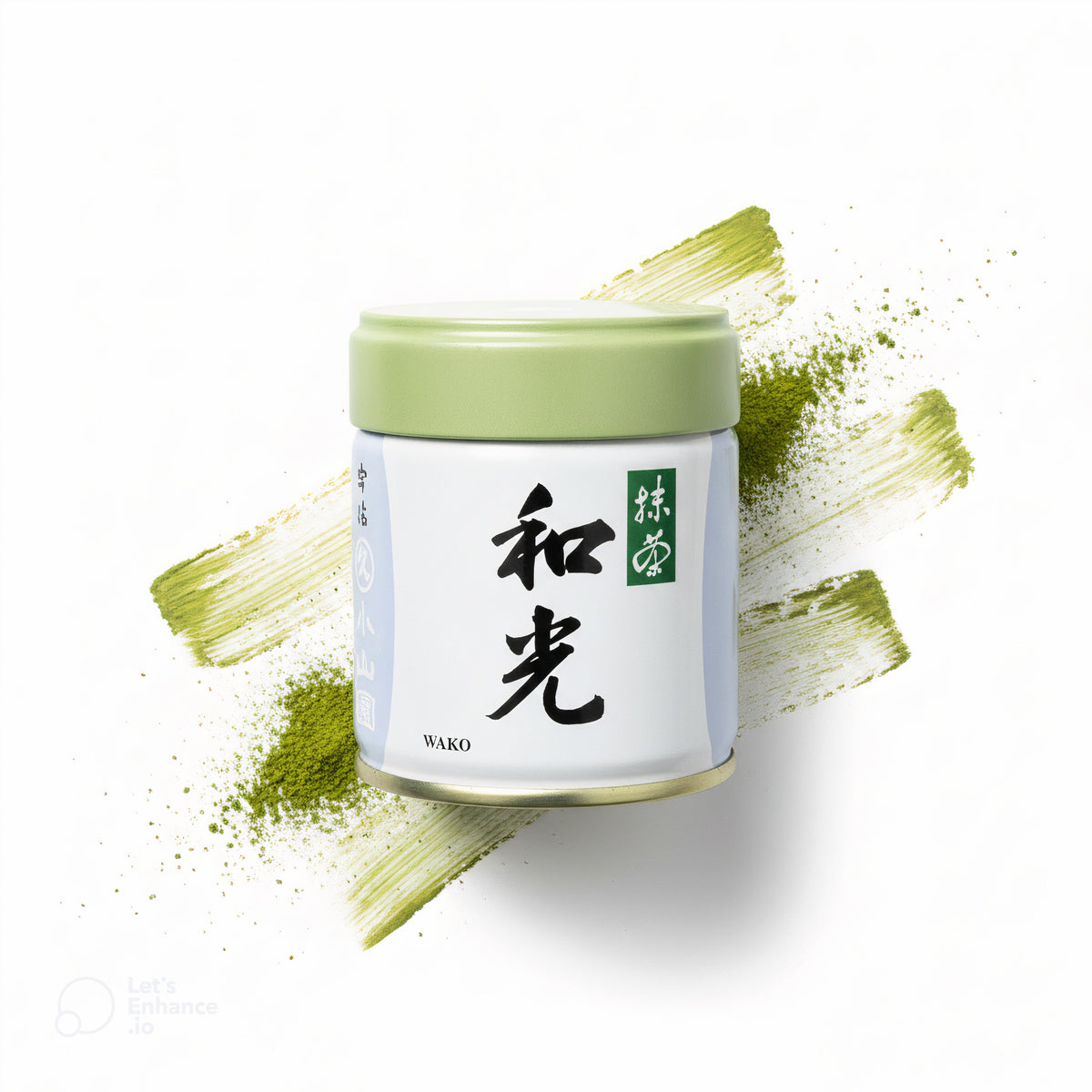
Short answer: for matcha lattes, start with Aoarashi. For a daily bowl of usucha with water, choose Isuzu, Chigi no Shiro or Yugen. For thick koicha, choose Kinrin or Unkaku. If you make matcha every day and want the lowest cost per serving, Wakatake in the 100g bag is the one. Below is every Marukyu Koyamaen matcha we carry, side by side.
Marukyu Koyamaen is a matcha house in Uji, Kyoto, and its lineup can be confusing from the outside. The tins have poetic names, not grade numbers, and the labels are mostly in Japanese. So we put the whole shelf into one chart, with real US prices from our store, cost per bowl and what each tea is best at.
The Marukyu Koyamaen matcha chart
Prices are SAINTCHA's US prices in October 2026. Cost per bowl assumes 2g of matcha per serving, the usual amount for one bowl of usucha or one latte.
| Tea | Size | US price | Per 2g bowl | Best for | Character |
|---|---|---|---|---|---|
| Wakatake | 100g bag | $49 | about $0.98 | Daily lattes, baking | Balanced, rich yet sweet |
| Aoarashi | 40g tin / 100g bag | $37 / $57 | about $1.85 / $1.14 | Lattes first, usucha second | Bright, refreshing, assertive |
| Isuzu | 40g tin / 100g bag | $42 / $67 | about $2.10 / $1.34 | Usucha and soft lattes | Creamy, mellow, gently sweet |
| Chigi no Shiro | 40g tin | $42 | about $2.10 | Usucha | Graceful and easy to drink |
| Yugen | 40g tin | $50 | about $2.50 | Usucha | Grassy aroma, mild bitterness, quiet umami |
| Wako | 40g tin | $52 | about $2.60 | Usucha, versatile | Smooth, light, clean finish |
| Kinrin | 40g tin | $55 | about $2.75 | Usucha and koicha | Rich and full-bodied |
| Unkaku | 40g tin | $60 | about $3.00 | Usucha and koicha | Sweet aroma, smooth, soft finish |
Stock moves fast, especially for the 40g tins. Our live restock tracker shows which sizes are available right now, and every sold-out tin has a button to email you when it is back.
How to read the lineup
Marukyu Koyamaen names its teas instead of numbering them, so you cannot tell from the name alone which tin is "higher". Price is a rough guide to position, but it is not a ranking of how good a tea will taste to you. A tea built for lattes and a tea built for koicha are designed for different jobs.
A more useful way to read the chart is in three groups.
The milk-friendly teas: Wakatake and Aoarashi. These have a confident green flavor and enough backbone to stay recognizable in a glass of milk. Wakatake is the working tea of the lineup: a 100g bag priced for daily use and cooking. Aoarashi is brighter and more refreshing, and still pleasant whisked with water.
The everyday usucha teas: Isuzu, Chigi no Shiro, Yugen and Wako. These are the teas we reach for when matcha is made with water only. Isuzu is the softest and creamiest of the group and also makes a gentle latte. Yugen tastes the most classic, with a grassy aroma and a light bitterness. Wako is smooth and versatile with a clean finish.
The koicha-capable teas: Kinrin and Unkaku. Koicha uses roughly twice the matcha and less water, so any harshness gets concentrated. Teas suited to koicha are naturally sweet and low in bitterness. Kinrin is rich and full-bodied; Unkaku has a sweet aroma and a soft, smooth finish. Both also make an excellent everyday usucha. Our guide to usucha vs koicha explains the difference in detail.
Why online "rankings" are unreliable
You will find lists online that rank Marukyu Koyamaen teas from one to twenty. Treat them with care. They usually mix teas the house sells in Japan with teas that are hard to find in the US, they rarely say where the order comes from, and they assume that more expensive always means better for everyone. For a latte, the opposite is often true: a delicate koicha tea gets lost in milk, and you have paid for sweetness you cannot taste.
That is why we describe every tin by how it is best prepared, not by the words "ceremonial grade". Ceremonial grade is a marketing term, not a certification.
Choose your tin in three questions
1. Will you drink it with milk? If yes, Aoarashi is our first pick, and Wakatake if you make a latte every day. If you like a softer latte, Isuzu. Our full guide to the best matcha for lattes goes deeper.
2. Will you drink it with water, as usucha? If yes, choose between Isuzu (creamy), Chigi no Shiro (graceful), Yugen (classic) and Wako (smooth). If you are deciding between the two most popular tins, read Isuzu vs Aoarashi.
3. Do you want to try koicha? If yes, Kinrin or Unkaku. Start with usucha for the first few bowls to learn the tea, then try a thick bowl at 4g of matcha to about 50ml of water at 80°C (176°F).
Still unsure? The 30-second Get fitted quiz asks how you drink matcha and suggests a tin, and the compare page puts any two tins side by side.
About the tins we sell
Every Marukyu Koyamaen tin at SAINTCHA is the producer's original pack, factory-sealed and never opened or repacked. Each product page shows a best-by month. We are an independent retailer in Seattle and we are not affiliated with or endorsed by Marukyu Koyamaen. The only product we pack ourselves is our Aoarashi refill, which is clearly labeled as a SAINTCHA refill and sold in 40g ($32) and 100g ($54) pouches.
Orders ship from Seattle within 1 to 2 business days, and US shipping is free on orders of $100 or more. You can see everything from this house in our Marukyu Koyamaen collection.
Frequently asked questions
Which Marukyu Koyamaen matcha is best for lattes?
Aoarashi for a bright latte, Isuzu for a softer one, and Wakatake for the best value if you make lattes every day.
Which Marukyu Koyamaen matcha can make koicha?
Of the teas we carry, Kinrin and Unkaku are suited to koicha as well as usucha.
How many servings are in a 40g tin?
About 20 servings at 2g each. A 100g bag makes about 50.
Is the most expensive Marukyu tin the best?
Not for every use. The pricier tins are smoother and sweeter, which shines in usucha and koicha, but much of that subtlety disappears in milk.